How Crypto Companies Are Marketing on TikTok in 2026

Over the past seven days, crypto social marketing split into two worlds: regulated brands used self-aware entertainment, cultural sponsorships and product demos with disclaimers, while memecoin affiliates sold speed, status and spectacular returns with little visible risk language. The broader tonal shift is away from price prediction and toward participation, identity, applications and live culture.
Crypto marketing is becoming entertainment before it becomes finance
The clearest pattern from September 5–12, 2026 is that leading crypto companies rarely open with a coin, chart or feature. They open with a recognizable entertainment format—trader memes, gaming competitions, sports clips, event interviews, celebrity news or animated characters—and introduce the product only after earning attention.
This is not one universal playbook. The market has separated into four distinct styles:
1. Large exchanges use comedy, sponsorships and carefully bounded product demos.
2. Wallets and memecoin apps lean into FOMO, absurdity and insider culture.
3. Chains and protocols sell builders, applications, access and ecosystem momentum.
4. NFT and web3 brands increasingly market characters, products and fandom without mentioning blockchain.
TikTok is generally the looser, more self-deprecating channel. Instagram carries more polished campaigns, ecosystem explainers, sponsorship footage and conversion-oriented product demonstrations.
Exchanges are hiding the sales pitch inside culture
Binance is operating like a trader-meme publisher
Binance’s TikTok feed was the most consistent example of entertainment-led brand marketing. Its recent posts used familiar native hooks such as “POV: your bro is trading with emotions,” “trading in 2026 be like,” “24/7 trading on Binance be like,” and “5 levels of trading music.”
The recurring subject is not wealth. It is the psychologically unstable life of a trader: dancing at charts, being ambushed by “the market,” waking up to trade and cycling through increasingly unhinged music while charts remain red.
Branding stays ambient—usually a Binance shirt, yellow mug or chart screen—rather than interrupting the joke with a feature list or sign-up instruction.


Among Binance’s observed TikToks, the emotional-trading skit generated the strongest engagement. That does not establish the format as the sole cause, but the full weekly set supports a broader pattern: relatable trader psychology resonated better than overt product explanation.
The strategic move is subtle. Binance is not promising that trading will make life better; it is building affinity by acknowledging that markets make users irrational, exhausted and occasionally miserable. That self-awareness is safer and more culturally fluent than permanent bull-market optimism.
Coinbase is pairing mainstream participation with security humor
Coinbase used two very different lanes. Its largest observed Instagram campaign was an open Valorant tournament hosted by a gaming creator, built around the hook “You’ve got ONE shot and that’s it!” Competitors face a one-life, one-round format, with Bitcoin functioning as the prize rather than the subject of financial advice.

This is a strong example of crypto becoming a reward layer inside an existing culture. The post speaks to gamers in gaming language, uses gameplay and scope graphics, includes a direct sign-up CTA and verbally acknowledges the Coinbase partnership.
The sampled comments focused heavily on eligibility, servers and how to register, showing that the creative successfully turned attention into operational questions. One commenter objected to presenting a crypto-linked competition to a young gaming audience, however, illustrating the reputational scrutiny that follows mainstream creator partnerships.
There is also a compliance detail worth fixing: the visible legal end card listed 2024 tournament dates even though the current post promoted an upcoming event. Reusing stale legal creative can undermine trust even when the campaign itself is compelling.
Coinbase’s second lane was low-stakes comedy. A cross-posted horror-movie sketch framed account verification as the behavior someone would prioritize before fleeing danger; another represented money as unavailable during a bank holiday.


These posts avoid price altogether. Coinbase is positioning itself around safety, access and mainstream usability, but doing so through visual jokes rather than conventional educational lectures.
Kraken separates conversion creative from brand equity
Kraken ran the clearest multi-lane portfolio on Instagram:
- A presenter-led Kraken Earn tutorial led with an “up to” yield claim, showed the staking flow and ended with formal volatility and slashing disclosures.
- An AI assistant demo opened with “I’m bullish on AI, what should I look into?” and showed the tool researching a mixed stock-and-crypto basket before leaving the final purchase swipe to the user.
- A Williams Racing fan-zone montage transferred excitement from Formula 1 to Kraken without discussing finance.
- A slow, surreal “Kraken Airlines” animation used HODL, WAGMI and “Destination: Moon” as cultural world-building.


The direct-response posts contain interface proof, clear value propositions and risk language. The sponsorship and entertainment posts contain almost no financial message. Kraken is not forcing one creative to perform awareness, education and conversion simultaneously.
Its AI positioning is especially notable: “It does the research. You make the call.” The product promises reduced complexity while preserving a language of user agency, rather than depicting an autonomous system that guarantees the right trade.
Crypto.com is selling spectacle and round-the-clock access
Crypto.com’s Instagram strategy similarly alternated between large-scale brand imagery and product-led comedy.
A CGI motorsport reel showed helicopters carrying an enormous branded race car through Madrid. A Burning Man-style piece used a dust storm, surreal characters and crypto-adjacent mascots. Neither asked viewers to transact.
Its product post put an anthropomorphic lion in an elevator with a user trading tokenized stocks. The message was not an investment thesis; it was that tokenized assets remain tradable at unconventional hours.


The company is using sponsorship-scale spectacle for memory and absurd narrative situations for feature communication. Direct financial risk language was not visible in the observed tokenized-stocks creative, making its treatment less explicit than Kraken’s product ads.
Robinhood Crypto was comparatively quiet
No official Robinhood TikTok or Instagram post from the exact seven-day window appeared in the verified account set. Search results around “Robinhood partner” were dominated by organic mentions and unrelated content; analyzed candidates did not establish paid relationships.
Robinhood Chain did generate creator commentary, but that is different from verified brand-led marketing. The distinction matters: search visibility can make a company look active even when creators are reacting organically to its product or ecosystem.
Solana is marketing an economy, not a token
Solana had the broadest content architecture in the sample. Its Instagram feed moved between community entertainment, founder credibility, product education, ecosystem data and cinematic ideology without centering the SOL price.
Event content turns attendees into the creative system
At Solana Summer House and regional gatherings, hosts asked attendees to describe Solana culture in three words, pass questions to the next person, guess how someone discovered Solana and play rock-paper-scissors for SOL.

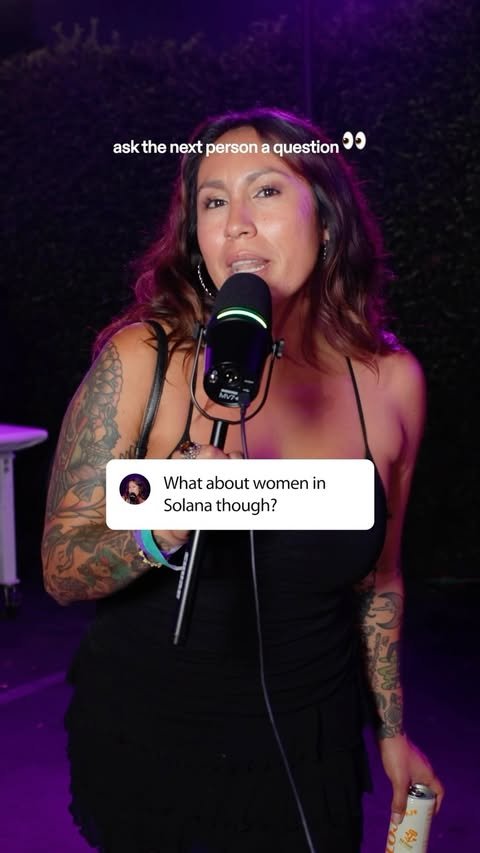


These posts share handheld microphones, animated subtitles, quick cuts and playful social tension. Solana itself is usually the topic or setting rather than the sales pitch.
The token giveaway is the most concrete demonstration: SOL is transferred through Phantom after a live game. That turns a wallet transaction into the resolution of an entertainment format rather than a dry tutorial.
Founder and expert clips make infrastructure legible
Other posts used founder interviews and external media credibility. Anatoly Yakovenko discussed reducing latency from seconds to milliseconds and the academic work supporting Alpenglow. A Bloomberg interview framed tokenized stocks as a global-access proposition. Another podcast clip argued that Solana must diversify beyond trading and meme coins.


None of these posts made a price prediction. Their recurring message was that sustainable growth requires better infrastructure, stronger founders and applications across more sectors.
The feed also contains a manifesto, explainer and newsroom
Solana’s cinematic campaign opened with “The world doesn’t change because people accept the rules,” then connected historical disruption to a “token supercycle” and an invitation to Breakpoint London. It was the highest-reach observed Solana post in the weekly official-feed set.

A creator-style explainer instead opened with “Solana just solved one problem that’s been holding back AI agents,” using a mini-microphone and living-room setting to explain payment channels. A weekly recap used green-screen screenshots and rapid metrics to present launches, transaction activity, tokenization and application revenue as one stream of momentum.


The strategic shift is from “buy SOL” to “here is what is being built, who is building it and what becomes possible.” Risk receives less attention in this lane; both the manifesto and recap presented progress almost entirely positively.
Wallet marketing is splitting between safety and memecoin theater
Phantom’s two observed TikToks captured crypto marketing’s central contradiction.
One began “POV: what happens when you put $20 on to Phantom,” then described copy-trading a memecoin, gaining dramatically within minutes and getting rich quickly. It contained no visible warning or downside framing.

A second post took the opposite position. Against a heaven filter, the creator explained to a sixteenth-century chimney sweeper why he bought animal-themed internet money, trusted cartoon avatars, briefly became rich and then lost everything in a rug pull.

The latter is a meaningful tonal evolution: loss is not hidden but converted into community humor. The former still reproduces the older “small deposit, spectacular return” fantasy. Audience comments on the optimistic post immediately challenged its realism and raised liquidity, demonstrating that crypto-native viewers will supply the missing counterargument themselves.
MetaMask had no verified official post inside the exact seven-day cutoff; its newest retrieved TikTok sat just outside it. Wallet tutorials were also a much smaller current content family than general crypto commentary, suggesting that cultural and narrative formats are presently carrying more attention than step-by-step wallet instruction.
Memecoin acquisition is running through semi-formal creator funnels
The most aggressive creator-led marketing was not attached to clearly disclosed sponsorships. It came from accounts that repeatedly displayed trading interfaces, extraordinary profit cards, referral codes, fee discounts, Telegram groups and “link in bio” funnels.
One high-reach montage followed creators through private jets, cars and luxury settings before revealing a trading gain and a fee-discount code. Another used political news about a supposed Hunter Biden token as the opening, then pivoted to the FOMO platform and a referral code.


Other formats included:
- “Did Solana just take over the Robinhood trenches?” over a screen-recorded token chart.
- “Gen Z is getting RICH off memecoins?!” over leaderboard screenshots.
- A Wolf of Wall Street montage with a seven-figure profit card and trading-fee referral.


No formal partnership was verifiable in those posts, and none displayed a clear sponsorship disclosure or meaningful risk warning. That does not prove there was no commercial relationship; it means viewers were not given enough information to distinguish organic usage, affiliate promotion and paid creative.
This affiliate layer is strategically powerful because it makes the product feel discovered inside trader culture. It is also the sector’s largest trust vulnerability. The visual grammar—huge return, social proof, urgency, bio link—functions like direct-response advertising even when the post does not identify itself as advertising.
Prediction markets are turning brand accounts into media pages
Polymarket and Kalshi are competing for attention by behaving less like financial products and more like sports and breaking-news publishers.
Polymarket uses three levels of product visibility
At the lightest level, the official Instagram account reposts remarkable or controversial news clips with a “TRENDING — Polymarket” badge but no market or odds. The brand becomes a watermark for “what the internet is discussing.”

Polymarket Sports used NFL hype footage without visibly showing odds or a product interface. Separately, a football creator placed a Polymarket championship-odds chart behind an emotional club rivalry rant. The market served as evidence inside the commentary rather than becoming the subject of an ad.


The official Instagram feed also carried an explicitly labeled partner caption around a sports prediction clip, showing that the brand combines owned media, product-adjacent creator content and disclosed partnerships rather than relying on one model.
Kalshi is building sports relevance before forcing the product
Kalshi Sports similarly repurposed locker-room interviews, coach moments and sports memes, frequently without showing a market. Its breakout weekly clip added a basketball-hoop gag to Lane Kiffin sideline footage; there was no visible app, odds display or CTA.

A separate creator skit briefly checked a Kalshi market inside a Ronaldo-versus-Messi joke. The product answered a narrative question, then disappeared.

On Instagram, Kalshi was more explicit: recent posts featured a Pete Sampras brand campaign, personalized trading recaps and percentage-based sports favorites. This reflects the wider platform split—TikTok grows topical audience affinity; Instagram carries more legible market framing.
The risk is that an account can accumulate sports-news attention that does not transfer to product understanding. Several high-reach posts contained no visible market, odds or CTA, so reach alone should not be treated as acquisition success.
NFT projects are becoming consumer IP companies
Pudgy Penguins offered the clearest example of the post-NFT tone. Its strong weekly TikTok used animated Pengu and Polly characters to demonstrate humorous “right” and “wrong” couple behaviors, then cut to physical plush toys and a link-in-bio CTA.

The post did not mention NFTs, tokens or blockchain. It sold affection for the characters first and merchandise second. A newer cross-platform character clip continued the same serialized entertainment model.
This is a major shift from explaining digital scarcity. The project is acting like an animation and toy franchise whose on-chain origin is background context, not the customer proposition.
OpenSea is moving in a related direction, but as a marketplace. Its current Instagram content included Gary Vaynerchuk discussing VeeFriends as a character universe, an unscripted first-use reaction to OpenSea Mobile and event attendees previewing the app.
A retrieved conference clip framed OpenSea as expanding beyond NFTs into broader on-chain trading and mobile onboarding, but that particular clip was several months old and therefore not part of the seven-day evidence window. It supports the positioning context, not this week’s trend count.
The hook formats defining crypto social this week
1. Trader-psychology POVs
Examples include “POV: your bro is trading with emotions” and “POV: you took your trading robot for a walk.” These hooks make the viewer recognize a behavior before asking them to process finance.
2. Time-sensitive revelation
“Did Solana just take over the Robinhood trenches?” and the Hunter Biden memecoin story create urgency through a new chain, person or event. The product arrives as the place to act on the revelation.
3. Extreme-outcome curiosity
“Gen Z is getting RICH off memecoins?!” and “what happens when you put $20 on to Phantom” foreground spectacular outcomes. They are effective attention devices but carry the highest credibility and compliance risk.
4. Declarative conviction
“I AM BULLISH ON SOLANA” immediately establishes a thesis. The stronger version then explains what the ecosystem must improve, rather than merely predicting appreciation.
5. Concrete problem-solution education
“Solana just solved one problem that’s been holding back AI agents” and Kraken’s yield explainer identify one obstacle, demonstrate one mechanism and show product proof.
6. Games and social challenges
Rock-paper-scissors for SOL, “describe the culture in three words” and Coinbase’s one-life Valorant tournament turn participation into the narrative engine.
7. Identity and character entertainment
Pudgy Penguins’ “How to eat your meal” does not explain the project. It invites viewers into a repeatable character relationship that can later support toys, media and community.
8. Cinematic manifesto language
“The world doesn’t change because people accept the rules” elevates infrastructure into a historical mission. This can create brand heat, but it needs technical and application proof elsewhere in the feed to avoid becoming empty futurism.
How brands are handling volatile narratives
Humor is replacing reassurance
Binance and Phantom do not tell audiences that volatility is temporary or that prices will recover. They portray emotional trading, red charts, rug pulls and market ambushes as shared experiences.
This reframes risk socially rather than financially: “we know this is chaotic too.” It is culturally effective, but comedy is not a substitute for risk communication when a post also makes a product or return claim.
Regulated brands compartmentalize risk
Kraken places disclosures around yield and AI-assisted investing while keeping F1 and entertainment content free of financial messaging. Coinbase uses security humor and legal terms around competitions. This compartmentalization lets the brand remain entertaining without placing every joke inside a disclaimer-heavy frame.
Ecosystems sidestep price volatility through utility
Solana focuses on latency, payments, tokenized stocks, local applications, builders and event culture. Uniswap’s latest retrieved official TikTok similarly used record gold prices as an educational entry point before explaining tokenized gold and zero interface fees.

This is narrative hedging: when token prices are unstable, the marketing proposition becomes access, infrastructure or application growth.
Crime stories are dominating crypto news attention
The Malone Lam Bitcoin-theft story was reproduced across multiple accounts with almost identical scripts, source footage and translated variants. These were generally publisher or creator posts, not exchange campaigns, but they shape the context in which brands advertise.


The implication is important: users encounter crypto brands beside stories about theft, scams and spectacular loss. Security cannot remain a help-center topic; it needs to be part of the public creative strategy.
Creator partnerships: fewer clear endorsements, more embedded distribution
The most unambiguous partnership observed was Coinbase’s gaming activation: the host verbally stated the relationship, Coinbase was visibly integrated and the post had a concrete competition CTA.
By contrast, searches for Coinbase, Robinhood, Phantom, Kraken, Binance and Crypto.com “partners” returned many false positives. Several analyzed posts merely mentioned a brand, showed a wallet or carried a hashtag without any visible evidence of sponsorship.
The more common distribution model was embedded product usage:
- A creator checks Kalshi inside a football skit.
- A football commentator uses Polymarket odds as a visual source.
- Memecoin creators show FOMO or Axiom dashboards and route viewers through referral links.
- Solana lets founders, event attendees and ecosystem builders supply the message.
This is more native than a conventional testimonial, but disclosure standards are uneven. Brands should distinguish three things publicly: paid sponsorship, affiliate compensation and ordinary product usage. At present, many viewers have to guess.
What changed in crypto marketing tone
From aspiration to self-awareness
Luxury and sudden-riches imagery still exists in the memecoin affiliate layer. Official brands, however, are increasingly joking about market stress, exhaustion, irrationality and losses. The industry sounds less like a motivational speaker and more like someone inside the group chat.
From tokens to things people can do
The most developed brands market competitions, AI research, staking flows, tokenized stocks, payment channels, mobile onboarding, toys, event games and sports debates. Tokens become prizes, rails or cultural props rather than the entire story.
From expertise to participation
Street interviews, chain questions, challenges and comment prompts ask the audience to contribute. Even technical ecosystems are turning users and builders into characters instead of relying exclusively on executives.
From “web3” to ordinary category language
Pudgy Penguins sells plushies. Polymarket publishes news. Kalshi publishes sports. Coinbase sponsors gaming. Kraken activates at Formula 1. Crypto.com creates entertainment spectacle. These brands are borrowing the language of established consumer categories instead of asking mainstream audiences to learn crypto terminology first.
From polished certainty to controlled absurdity
Anthropomorphic lions, trader robots, heaven-filter rug-pull monologues and giant race cars are replacing sterile fintech explainers. The product remains serious, but the surrounding creative is intentionally strange enough to earn attention.
Strategic takeaways for crypto marketers
Build separate lanes for reach, proof and conversion
Do not make every post explain the product. Binance’s memes, Kraken’s split between product and sponsorship, and Solana’s mix of community, technical and manifesto content show the value of assigning each creative one job.
Make the product the resolution, not the opening
The strongest integrations arrived after a story was already moving: SOL completed a live challenge, Kalshi answered a football question, FOMO enabled action on a breaking memecoin narrative and tokenized stocks solved the trapped-in-an-elevator setup.
Treat volatility as culture—but disclose it as risk
Self-deprecating loss humor is more credible than relentless bullishness. When a post displays a yield, dramatic return or fast trade, however, regulated-style risk language and transparent commercial disclosure should accompany the joke.
Use creators for access to an existing world
Coinbase did not ask a finance influencer to describe Bitcoin. It placed Bitcoin inside a gaming tournament. Polymarket works through football emotion. Solana uses builders and attendees. The creator’s culture should determine the format; the crypto product should provide the mechanic, proof or payoff.
Turn ecosystems into recurring editorial franchises
Weekly ecosystem news, founder clips, local product questions and event interviews give Solana repeatable formats rather than isolated announcements. Protocols with complex stories can adopt the same model: one recurring show for metrics, one for builders, one for users and one for cultural participation.
Close the affiliate disclosure gap
Referral-led memecoin content is already functioning as a distributed acquisition channel. Brands and platforms should require visible affiliate wording, distinguish hypothetical from realized returns and place risk information before the bio-link conversion—not only in external terms.
Bottom line
Crypto’s strongest social marketers are no longer trying to make financial advertising look exciting. They are making entertainment, sports media, gaming competitions, character IP and event culture that happens to contain a financial product.
The winning tone is participatory, self-aware and application-led. The unresolved fault line is trust: official brands increasingly acknowledge complexity and risk, while the affiliate memecoin economy still relies heavily on extraordinary gains, urgency and ambiguous commercial relationships.


